Power, Passion, Partnership: what “Engineered for the Sea” means at Heila Cranes
September 11, 2026

When two crane offers land on the same desk, the comparison usually starts with a single number. It should start with the load chart. The chart is the most compact description of what a marine crane can do on your vessel, and it is also the easiest document to misread.
This guide explains how to read a marine crane load chart the way our engineers do, using figures from the HEILA Cranes 2026 catalogue. All capacities quoted here are horizontal loads, lifting by hook, in harbour conditions.
Tonne-metres describe the crane, not the heaviest load
HEILA Cranes rates its range from 3 tm to 1,500 tm. A tonne-metre is a tilting moment: the load multiplied by the distance at which it is lifted. It measures the overall lifting capability of the crane, not the heaviest load it can pick up.
That is why a 1,500 tm crane does not lift 1,500 tonnes. The HLRM 1500-2S, the largest model in the catalogue tables, is rated at 83,000 kg at 11.00 m. The rating tells you how much moment the structure is designed for. The load chart tells you how that moment becomes kilograms at each outreach.
Read every marine crane load chart as pairs of values
Every value in a load chart is a pair: a load and the outreach at which that load is rated. A capacity without its outreach says very little.
Take the HLRM 440-4S, from our best-selling HLRM 440 series. It lifts 55,000 kg at 5.71 m. At 17.69 m, the same crane is rated at 15,200 kg. Both figures are correct and both describe the same machine. The question is which one matches your operation.
Start from the job: the heaviest load you need to handle and the furthest point from the crane where you need to place it. Then find that point in the chart. If the load you need is available at that outreach, the crane is a candidate. If it is only available closer to the crane, it is not.
Boom extensions change the whole curve
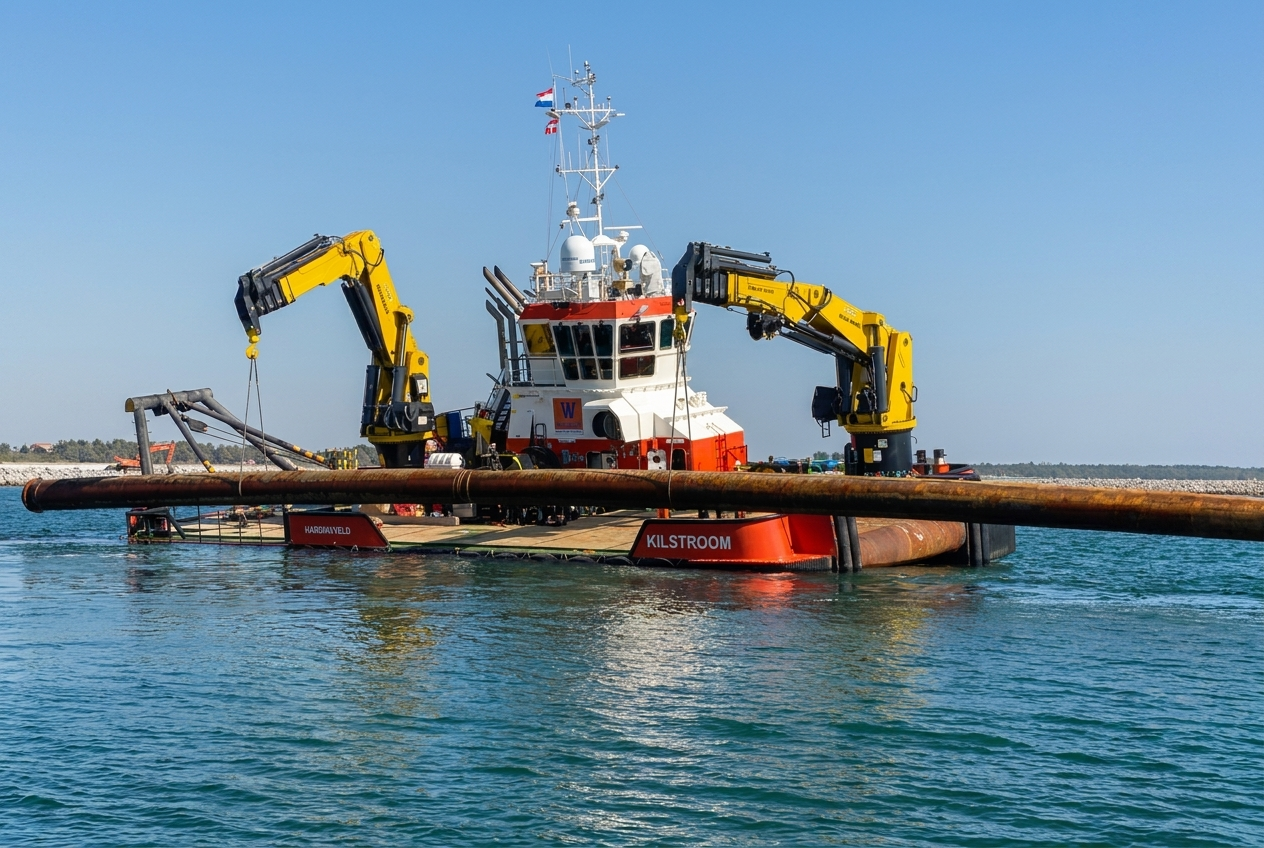
Each model is offered with a different number of boom extensions, marked in the chart as 2S, 3S, 4S and so on, and some models also have SL versions. More extensions give more reach, and they also change the capacity at shorter outreach. Compare two configurations of the HLM 25, from our HLM series:
| Configuration | Load at shortest outreach | Load at maximum outreach |
|---|---|---|
| HLM 25-2S | 5,170 kg at 4.68 m | 2,820 kg at 8.62 m |
| HLM 25-5S | 4,520 kg at 5.04 m | 1,200 kg at 14.72 m |
The 5S boom reaches about six metres further, and in this example it carries less at short outreach. When you compare offers, compare the same number of extensions, or compare different configurations at the outreach you actually need.
Harbour duty is the reference, offshore duty is another matter
The catalogue marine crane load charts refer to harbour conditions. They are the reference values for comparing cranes on paper.
Offshore duty is a different context. HEILA marine cranes can be designed to operate in different sea conditions, and they can be fitted with a sea state selector switch on the control panel, fixed or wireless, so the operator selects the type of operation for the conditions. When a crane will work offshore, make the significant wave height part of the specification from the start. For subsea and offshore lifts where vessel motion matters, read also our article on Active Heave Compensation.
Hook or winch: check what the chart assumes
The values in the catalogue tables are for lifting by hook. Many operations need a winch instead.
HEILA cranes can be equipped with a winch, with a pulley head integrated into the last boom extension or a pulley block that connects when required, and with single or multiple line pull. Winch capacity is a parameter of its own: HEILA winches range from a single line pull of 500 kg to more than 50 t. Ask for the rating of the configuration you will actually operate.
Safety systems belong in the comparison
Two cranes with similar charts can differ in how they protect themselves and the vessel. HLM cranes feature an electrohydraulic load moment limiting device that prevents the crane from being overloaded. HLRM cranes have an electronic safety system that protects the crane from overload.
For offshore work, protection goes further. AOPS protects the crane against overload and overturning moment by allowing the hook to be pulled away in a controlled manner. With MOPS, the operator is warned to release the winch manually. AOPS/MOPS is mandatory for certified offshore cranes performing ship-to-ship or ship-to-platform lifts. Acoustic and visual alarms, a green, yellow and red light at 90%, 100% and 110% of SWL, are mandatory on fully IACS certified cranes.
Key takeaways
- A marine crane load chart is a set of pairs: a load and the outreach it is rated at.
- A rating in tm is a tilting moment, not a maximum load.
- Always read a capacity together with its outreach.
- Compare the same number of boom extensions, or compare at the outreach you need.
- Catalogue charts refer to harbour duty: specify the significant wave height for offshore duty.
- Check whether a value assumes a hook or a winch, and which safety systems are included.
Certification is part of the comparison
HEILA cranes comply with ISO 19354, the ISO standard for marine cranes, and can be certified under the rules of the major classification societies: ABS, BV, CCS, DNV, LR and RINA, among others. If required, they also meet EN 13852-1 and API-2C.
Send us your lifting profile
The fastest way to the right crane starts from the operation: loads, outreaches, the vessel and the conditions at sea. That conversation is faster, and more accurate, than comparing marine crane load charts in isolation. Share the details with our team through the Request a Quote page or write to sales@heila.com, and our engineers will match them to the HEILA range.