How to read a marine crane load chart
September 18, 2026
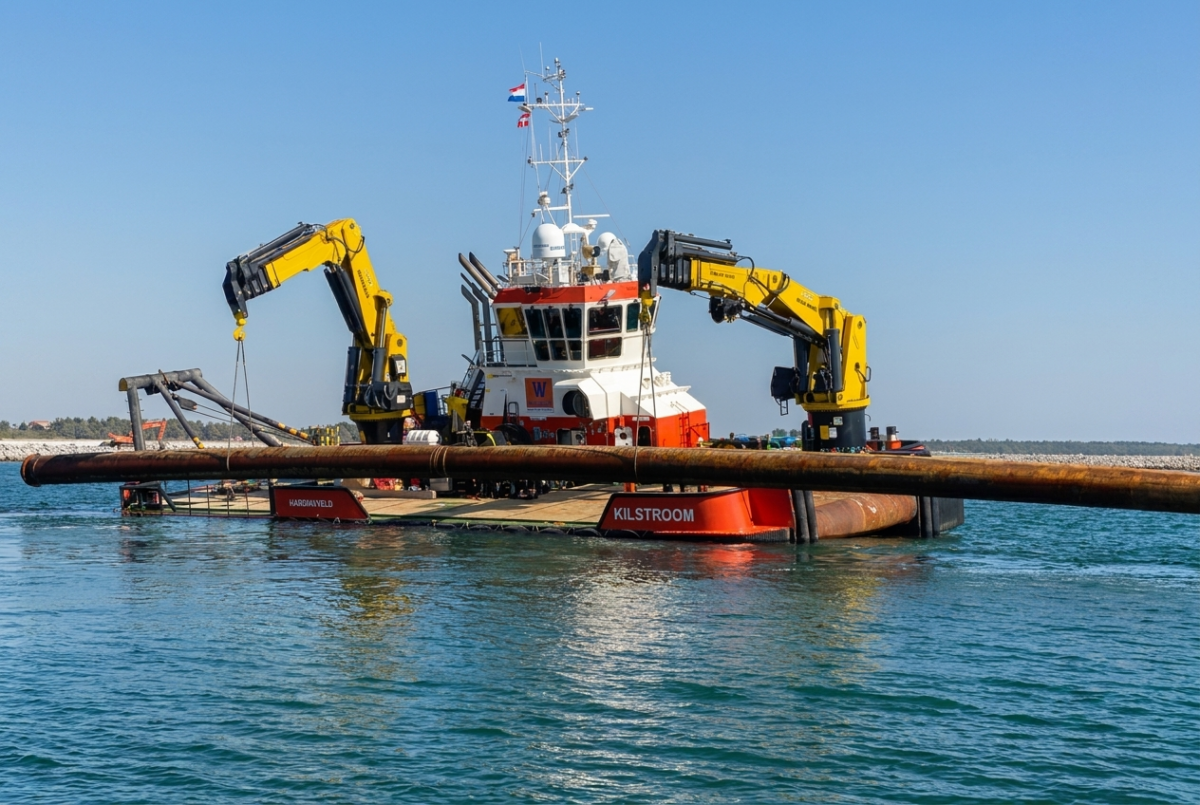
Every deck crane specification starts from the same three numbers: the load, the distance it has to travel, and the space the vessel can give the crane when it is not working. The three rarely agree. A crane sized on capacity alone eats deck space; a crane chosen for its folded footprint can run out of capacity exactly where the operation needs it.
The configuration is what reconciles them. A foldable telescopic crane, a knuckle telescopic crane and a knuckle boom crane can all be specified at a similar rating in tm and still behave differently on the same deck. This article sets out what each configuration is built to do, so the choice can be made before the load chart comparison rather than after it.
The foldable telescopic crane: compact, light, safe at angle
The HLM series is fully foldable telescopic and slews on a double rack and pinion with bronze bushes. Rotation goes up to 360°, and the arrangement allows safe operation even at higher heel and trim angles.
Doubling racks and cylinders doubles the slewing power, and the shared load extends component life. One cylinder serves multiple telescopic movements, which keeps the crane light and simple to maintain.
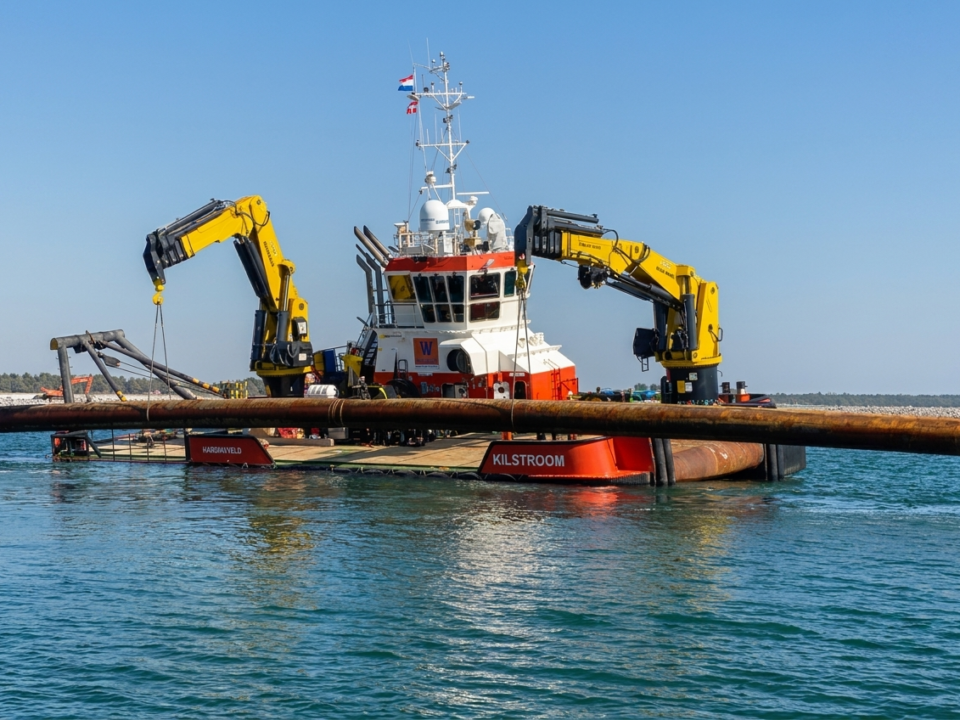
These cranes work in any configuration, with the boom extended upwards or folded downwards. They are very compact and light, which makes them suitable for small vessels where space is limited: multifunctional workboats, tugs and pontoons. They can also work offshore. The range runs from HLM 3 to HLM 25, and the HLM series article covers the line in detail.
An HLM 25-5S is rated 4,520 kg at 5.04 m and 1,200 kg at 14.72 m. Both values are horizontal loads, lifting by hook, in harbour conditions.
When deck space is the constraint: knuckle telescopic
The HLRM series slews on a slewing bearing, which gives continuous slewing. It is available in two configurations, and the difference matters.
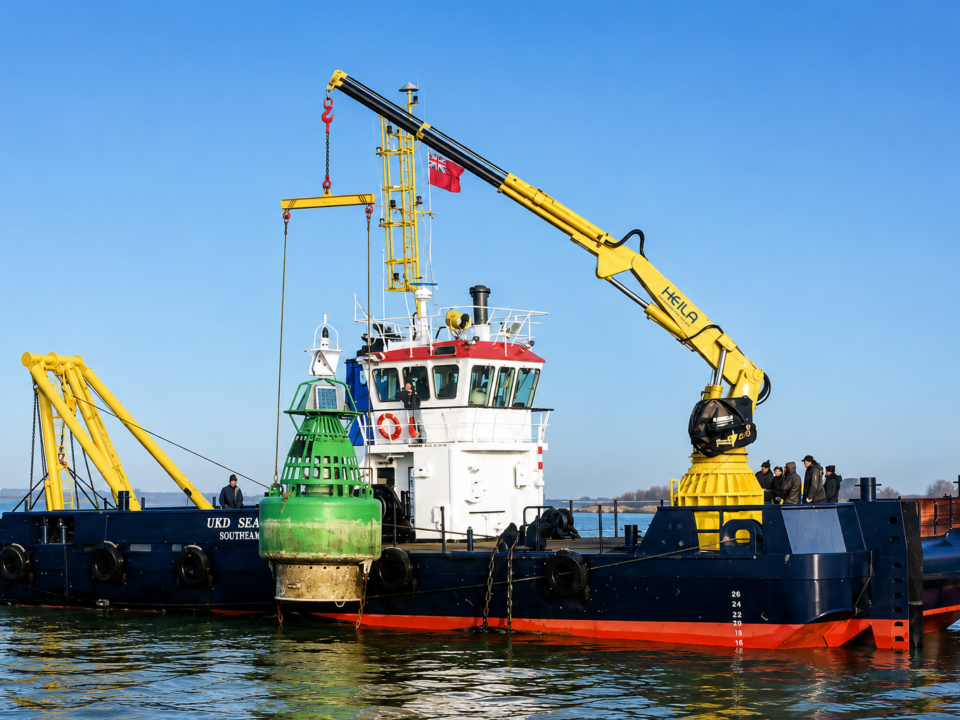
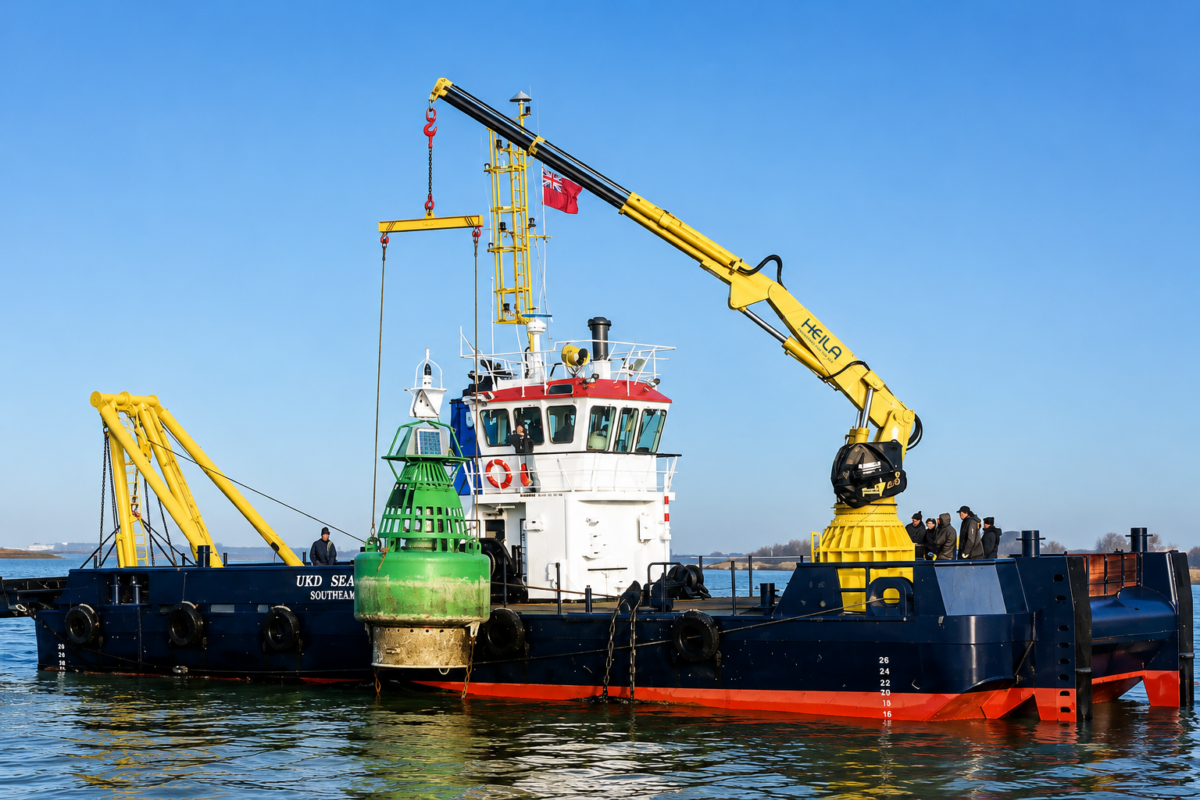
As a fully foldable telescopic crane, the HLRM delivers the best lifting performance of the range, combining boom strength with slewing ring rotation. It suits buoy handling and the hoisting of structures and equipment. Together, HLM and HLRM fully foldable telescopic cranes cover 3 to 90 tm.
As a foldable knuckle telescopic crane, the HLRM covers 80 to 1,500 tm. This is the configuration to specify when high capacity is required and deck space is limited, and it serves customers from the fishing industry to the offshore sector. Cranes are standard or completely custom made.
The HLRM 440 is the best seller of the line: maximum lifting capacity 55 t, reach up to 23 m, compact and lightweight for its size. An HLRM 440-4S is rated 55,000 kg at 5.71 m and 15,200 kg at 17.69 m, again horizontal loads, lifting by hook, in harbour conditions. At the top of the range, the HLRM 1000 lifts up to 70 t with outreach up to 30 m and is suitable for subsea work.
Reach, lifting height and load sway: the knuckle boom
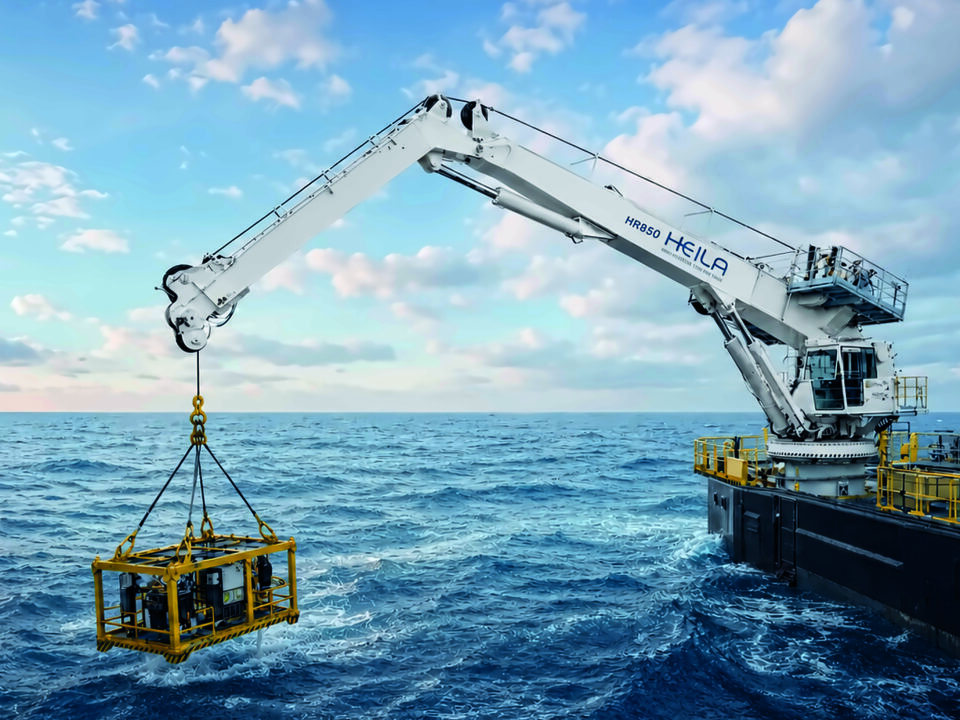
The HR series is devoted to subsea operations and is fitted with active heave compensation, AOPS and MOPS. A knuckle boom increases both reach and lifting height.
It also changes how the load behaves. Keeping the boom tip close to the load in all positions reduces load sway, which is the difference between a lift that can be placed and a lift that has to be waited out.
The HR-2BJ offers a large working area, is easy to adapt for ATEX environments and is designed for low maintenance, up to 1,500 tm and customised.
What the configuration changes beyond the boom
Two cranes with the same rating can carry very different equipment, and the configuration influences what is worth fitting.
Control runs from a standing platform or local operator panel to an operator cabin, remote control or radio remote control. Hoisting winches cover single line pull from 500 kg to more than 50 t, with a load limiting device and non-rotating galvanised steel wire. A constant tension winch pays in or out to hold a pre-set line pull, which is what buoy laying and floating pipeline work need.
Duty matters as much as capacity. Harbour duty and offshore duty are not the same specification: offshore work brings the significant wave height into the conversation, handled with a sea state selector switch, and AOPS or MOPS becomes mandatory for certified offshore cranes performing ship-to-ship or ship-to-platform lifts. HLRM heavy duty cranes carry a standard design temperature of -20 °C to +45 °C and a minimum of IP56 on all electric cabinets and junction boxes.
Cranes comply with ISO 19354, Ships and marine technology. Marine cranes. General requirements, with EN 13852-1 and API-2C if required, and are certifiable under ABS, BV, CCS, DNV, LR and RINA on request. Structural integrity is checked in house with 3D CAD, verified ANSYS software and FEA.
Key takeaways
- A foldable telescopic crane is the compact, light answer for small vessels, and stays safe at higher heel and trim angles.
- Knuckle telescopic is the answer when high capacity has to fit a limited deck, from 80 to 1,500 tm.
- A knuckle boom buys reach, lifting height and a steadier load, which is why the HR series is built for subsea work.
- tm is a tilting moment, load multiplied by outreach, so configurations rated alike can perform differently at the distance you actually work.
- Duty, control, winch and certification shape the specification as much as the boom does.
Matching a configuration to your vessel
The useful starting point is not a model number. It is the deck layout you can offer, the loads you need at the distances you work, and whether the duty is harbour or offshore. With those three, matching a foldable telescopic crane, a knuckle telescopic crane or a knuckle boom to the vessel is a short conversation rather than a long comparison. Reading the figures correctly helps too: our guide on how to read a marine crane load chart explains what the numbers assume.
Send your requirements through the Request a Quote page or write to sales@heila.com, and our engineers will match them to the HEILA range.